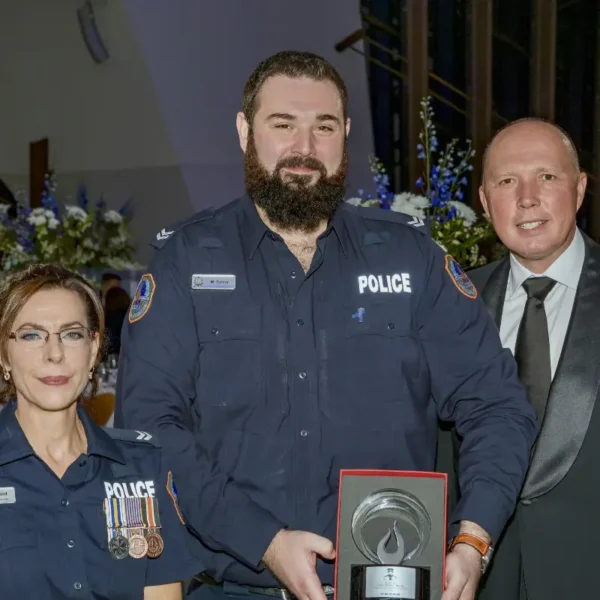
This article describes PTSD, suicidal thinking and treatment for both. If you need support now, call Lifeline on 13 11 14, or 000 in an emergency.
For the best part of two decades my job was to talk to people on the worst day of their lives. As a police officer, negotiator and investigator in London, Western Australia and the Northern Territory, I dealt with suicides, homicides, child abuse, fatal crashes and disasters, and then went home and tried to be a normal dad.
Everyone in policing knows people for whom that eventually catches up. Early in my career, the unwritten rule was that you dealt with it at the pub, not in a doctor’s office. When I did ask for help, I found that trauma therapy is very hard to do while you are being exposed to fresh trauma every week between appointments. Medication took the edge off for a while, then stopped working.
When I left policing, and later parliament, the structure that had kept me going fell away. In 2025 I reached the point where I could no longer see a way forward. I am saying that plainly because I know how many people are sitting in that same place right now, and how quiet it can be.
What I had, and what too many people do not, was a light on the hill. In 2022, as a member of the Legislative Assembly, I spoke in Parliament about psychedelic-assisted therapy and the evidence coming out of clinical trials. In February 2023, in response to applications lodged by Mind Medicine Australia, the Therapeutic Goods Administration rescheduled MDMA and psilocybin for clinical use, making Australia the first country in the world to do it. From 1 July 2023, specially authorised psychiatrists here have been able to prescribe MDMA for PTSD. I did not know then how much I would come to need it.
Knowing a treatment is legal is not the same as being able to get it. When you are that unwell, even booking appointments and chasing referrals feels beyond you. I could not find an authorised psychiatrist in the Territory, so treatment meant flying to Melbourne. The quote for the treatment was about $23,000, before flights and accommodation. I spent months on paperwork trying to fund it, and Mind Medicine Australia’s Patient Support Fund helped close the gap.
The Patient Support Fund helps people access psychedelic-assisted therapy when they otherwise couldn’t afford it. It runs entirely on donations, and our goal is to reach $2.5 million to help more Australians access this life-changing treatment.
Donate to the Patient Support Fund
MDMA-assisted therapy, one of the psychedelic-assisted therapies now legally available in Australia, is not what people imagine. It started with a psychiatrist’s assessment and weeks of preparation sessions. Each of my three dosing days was about eight hours in the clinic with a clinical psychologist and a therapist, followed by integration sessions to make sense of what came up. The three doses were spread over about five months.
The first gave me something I had not felt in years: relief, and a sense that there might be a path forward. The second was harder and more physical, as if my body was letting go of things it had been holding. The third felt like bringing the pieces together. As I put it at the time, that is the point where the work has happened, and now we need to integrate it. The memories I had avoided for decades are still there, but they feel like memories now, rather than something happening all over again.
I want to be careful here, because people who are struggling deserve honesty more than a miracle story. This did not cure me. It did not erase what I have seen. What it did was give me enough space to start working through it, and I am still doing that work with my treating team. The medicine opened a door; I still have to walk through it every day. It is not right for everyone. The medicines themselves are still classed as unapproved, which is why access is so tightly controlled, and anyone thinking about this should start the conversation with their GP or psychiatrist.
People often ask what the treatment actually felt like, beyond “it helped.” Here, in my own words, is what changed.
Threat response and vigilance
The MDMA turned down my hypervigilance. During the sessions I kept returning to the same phrase: the amygdala is off, the vigilance is not there. What replaced it was a warm peacefulness in my chest. That shift is what allowed me to go near memories that would ordinarily have produced a shutdown or a panic response.
A buffer, not a switch
The clearest practical effect is that a space opened between a stimulus and my response. Where stress used to trigger an automatic reach for a drink, or for avoidance, there was now a beat in which I could choose. The MDMA acts as a buffer, and the buffer gives me the opportunity to decide.
Memory
My traumatic memories now sit further back. They feel filed into the past rather than running alongside the present. That recontextualisation cut the immediacy of sensory triggers. Smells that used to set off panic no longer land the same way. When I come across them in life, there is now a gap to react in. The mind is automatic and cannot be controlled, but in that gap I can remember that I am safe, that I am present, and that this too will pass. It does not cure the PTSD, but it gives me hope and a way to look forward, and that, for me, seemed to soothe the suicidal ideation. If that was the sole benefit, it was a success.
What also came back was the good material. I could reach childhood feeling I had lost: sitting in the paddling pool, playing with my sister, the sense that the world was good. I had not had access to that in a very long time.
Grief
The medicine let me feel grief and sadness I had kept boxed up for years. After the early dosing, the suicidal thinking switched off. What came in its place was authentic feeling rather than the performed version I had been running. The MDMA showed me an alternative to the advice I was given as a junior police officer. I did not need to sit down with a bottle and lock the feelings in a box. I needed to feel them, to process them and to accept them.
Parts and identity
To use the language of internal family systems, or, for anyone with children, the language of the film Inside Out: my protector part shifted role. It had been a full-time hyper-protector, and it was able to take a deep breath and sit back. There has been real work in this, bringing the eight-year-old in, apologising to him, offering reassurance, and letting those parts be included rather than exiled.
There is a cost in that which I want to be honest about. Losing the grip of the PTSD feels like losing a superpower. It was the thing that kept me functioning in high-threat work, and there is genuine anxiety in the question: what am I without it? I am finding the answer in other roles, in caregiving, study and relationship, but I do not want to pretend the question does not sting.
“Losing the grip of the PTSD feels like losing a superpower.”
Day to day
My drinking dropped away. Years ago I was drinking heavily and still functioning, then I sobered up, and now I can have a social glass of wine and know that it no longer controls me. My reliance on medical cannabis dropped too. That plant took the edge off the antidepressant withdrawal, and anyone who has come off an SNRI knows how much that hurts. None of that was willpower. The buffer simply meant the old reflex did not fire. I am more socially present, and I can enjoy small moments again: walking, noticing the light. Friends and family have noticed the change. I can meet people and have fun, and I do not have to hide all of the time. There are still bad days, but they are not bad years or bad months, and I can sit with whatever capacity I have left and enjoy it.
Integration
The protocol allows for up to three doses. I have heard both three-month and six-month guidance from clinicians on when further dosing might be considered, and those questions still need answers as this treatment matures in Australia. Whatever the interval, my clinicians and I are focused on consolidating the gains rather than treating the medicine as a one-off cure: notes, journaling, social reintegration, gentle practice, longer breaks between sessions where advised, lying down and resting when I need to, and a walk afterwards. It makes you better at feeling, and everything after that is the work of integration.
“It makes you better at feeling, and everything after that is the work of integration.”
Limits and cautions
MDMA is not a delete key. The memories remain. What changes is their context and their emotional charge, and sensory triggers can still exist. Other psychedelic work, including ayahuasca and ketamine, came up in discussion with real caution attached, because some people get worse after non-clinical experiences. I also noticed myself trying to box up the session so I could recall it later — memory for the session itself is imperfect, which is a further reason the integration practices matter.
In short, this course moved me from emotional re-awakening into integration. My background vigilance is down. My traumatic memories have been recontextualised and are less trigger-driven. Positive early memories are available to me again. My internal parts have started to reorganise so my protector can finally relax. What remains is a lingering question about who I am without the PTSD, and a clear need for careful, structured integration to hold and extend the gains in life.
So why speak publicly? Because I have watched too many police officers and other first responders run out of options. Because eligible veterans can now have this treatment funded through the Department of Veterans’ Affairs, and I am not aware of any equivalent pathway for police, paramedics or firefighters. And because cost and distance should not decide who gets a chance to recover, especially in the Northern Territory.
If you are a police officer or first responder, or you love one, and that quiet place sounds familiar, please talk to someone today. I am not a clinician, but if you want to hear what it was actually like, I am happy to talk. You can reach me through Mind Medicine Australia at [email protected].
If you need support now, call Lifeline on 13 11 14, or 000 in an emergency.
Mark’s treatment was part-funded by the Mind Medicine Australia Patient Support Fund.
The PSF exists for people with treatment-resistant depression or PTSD who have a diagnosis, an approved prescriber and no way to pay. Every dollar in it was put there by someone who decided cost should not decide who recovers. Donations over $2 are tax deductible.
Donate now | Read about the Patient Support Fund
Mark Turner is a former police officer, negotiator and investigator who served in London, Western Australia and the Northern Territory, and a former member of the Northern Territory Legislative Assembly. He is a member of Mind Medicine Australia’s Lived Experience Panel, a recipient of the Patient Support Fund, and a father of six.
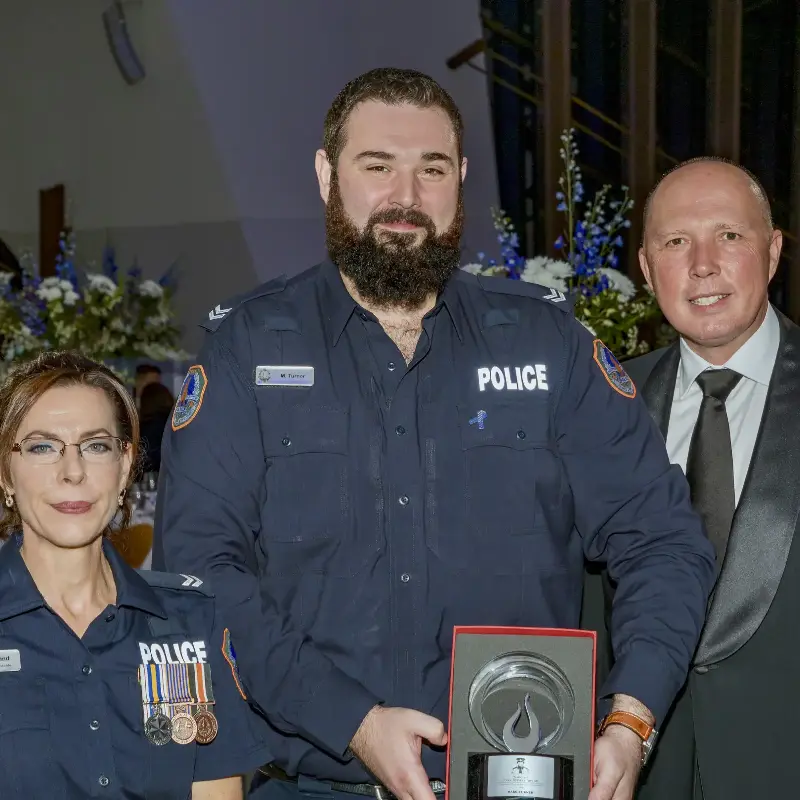
Mark Turner spent the best part of two decades as a frontline police officer, serving with London’s Metropolitan Police (2002 to 2009), Western Australia Police (2009 to 2013) and the Northern Territory Police (2013 to 2020), where his roles included hostage and crisis negotiator and senior investigator. In 2019 he and a fellow negotiator received the National Police Bravery Award for preventing a suicide, and in 2022 both were further recognised with Royal Humane Society of Australasia bravery awards. From 2020 to 2024 he was the Member for Blain in the Northern Territory Legislative Assembly.
In 2025 Mark’s mental health reached crisis point. Years of talk therapy and medication had not given him lasting relief, and he could no longer see a way forward.
In 2026 he completed MDMA-assisted therapy for PTSD, also known as MDMA-assisted psychotherapy, through the TGA Authorised Prescriber scheme at the Mind Medicine Australia Clinic in Melbourne, supported by Mind Medicine Australia’s Patient Support Fund. Mark describes it not as a cure, but as the treatment that gave him enough space to start working through what he had carried for so long. That work continues.
A father of six, Mark wants police officers, paramedics, firefighters and other first responders living with PTSD to know that legal treatment options now exist under strict medical controls, even though they are not right for everyone. He is committed to reducing the cost and access barriers, particularly in the Northern Territory, and is happy to talk with serving and former police officers about his experience.