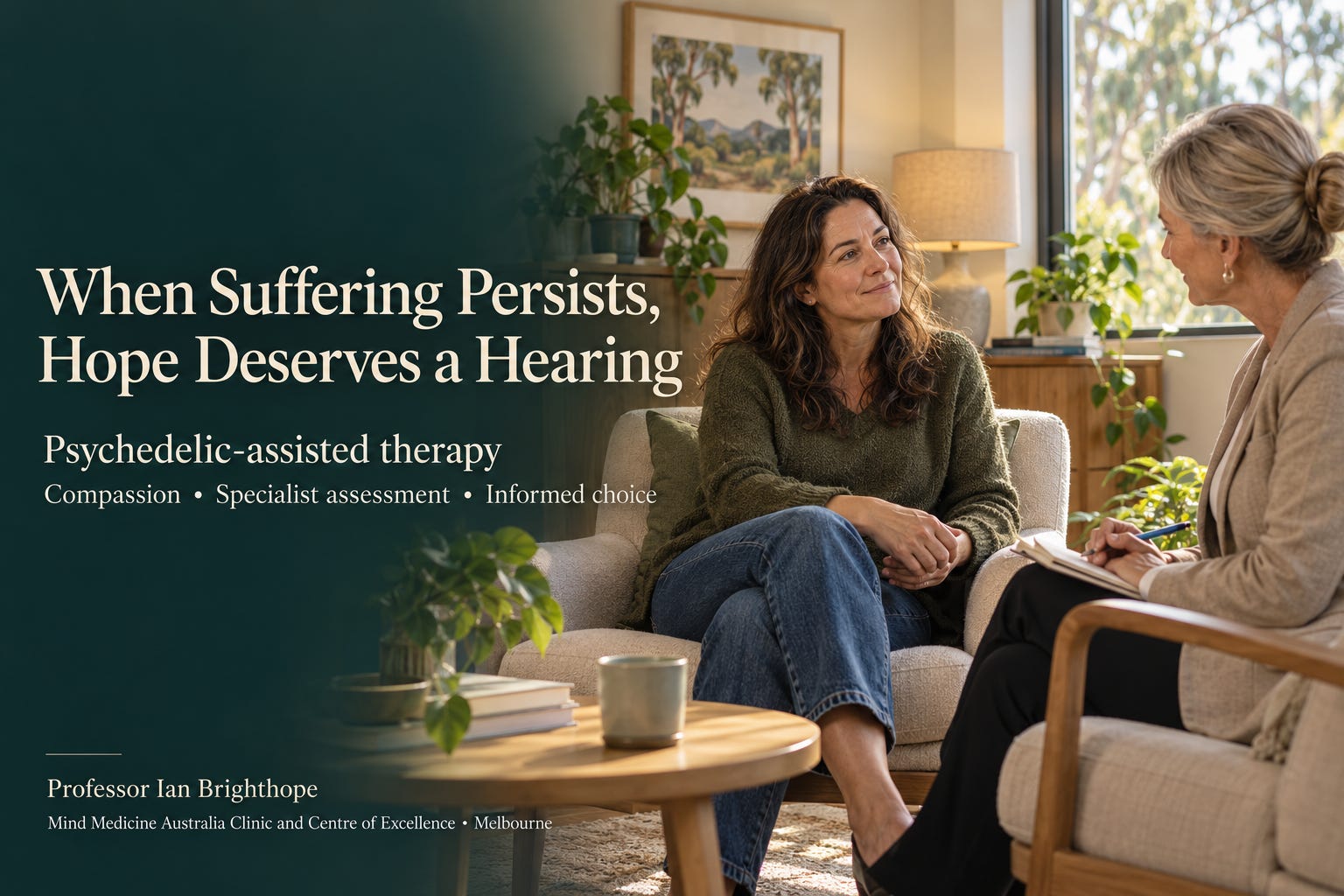
Why I support specialist assessment at Melbourne’s Mind Medicine Australia Clinic and Centre of Excellence
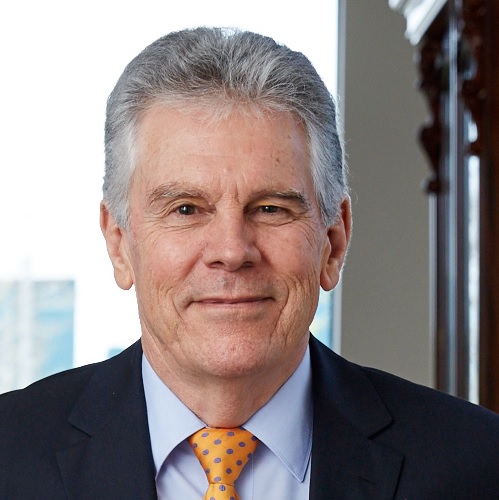
By Professor Ian Brighthope
Throughout my decades in nutritional and environmental medicine, I have held firmly to one principle: we must care for the whole person, and we must keep searching when suffering persists.
Mental illness can rob people of their relationships, their livelihoods, their confidence and their sense of a future. For someone living with persistent depression or the consequences of trauma, being told to endure another year of inadequate relief is a heavy burden.
These people deserve compassion, careful reassessment and an honest discussion of the available options.
It is in that spirit that I draw attention to the Mind Medicine Australia Clinic and Centre of Excellence in Abbotsford, Melbourne, and recommend it as a service to discuss with your treating doctor when established treatments have not provided sufficient benefit.
The clinic describes an individually tailored model involving psychiatry, psychology and allied health, with specialist assessment and psychological support throughout treatment. That comprehensive approach is central to why its work deserves consideration. My recommendation is to seek a qualified assessment; whether treatment is appropriate must remain an individual clinical decision.
Hope must be accompanied by honesty
Psychedelic-assisted therapy is an emerging area of psychiatric care. It combines 2-3supervised medicine sessions with psychotherapy, including preparation beforehand and integration afterwards.
The therapeutic relationship, the setting and the continuing support matter. A powerful experience alone does not establish that someone has recovered. However, the remission rates from hundreds of trials conducted around the world and in over 450 patients in clinics in Australia demonstrates a 60-80% remission rate. This is far in excess of the remission rates from existing treatments for depression and post-traumatic stress disorder.
The Royal Australian and New Zealand College of Psychiatrists emphasises that outcomes vary, some people do not improve, and the duration of benefit remains uncertain. Difficult experiences can also cause harm. These uncertainties exist with every medical treatment option and belong in every informed discussion.
I believe we can take that uncertainty seriously while still recognising the importance of exploring options for people whose lives remain profoundly restricted by illness.
What are the permitted indications?
Australia’s restricted Authorised Prescriber pathway distinguishes two uses:
Prescribing requires a specifically authorised specialist psychiatrist and the relevant ethics approval. There are over 120 Authorised Prescribers and over 20 Clinics in Australia and these numbers are increasing rapidly. These products remain unapproved therapeutic goods: access through this pathway does not mean the TGA has evaluated them for safety, quality and effectiveness as registered medicines. Other indications remain restricted to medical and scientific research, including clinical trials. There is now promising research showing psychedelic-assisted therapies could also be a valuable treatment for addicitions, eating disorders, obsessive compulsive disorder, end-of-life stress and anxiety, general anxiety disorder, strokes, fibromyalgia, cluster headaches, Parkinson’s and cognitive decline and more.
The clinic’s eligibility form requires a formal diagnosis of PTSD or treatment-resistant depression and asks about previous medication treatment without adequate benefit. A diagnosis alone does not establish suitability.
Contraindications and reasons treatment may be unsuitable
Responsible care begins with knowing when to proceed, when to defer and when another approach is safer.
An important distinction is necessary here: the clinic’s public pages reviewed for this article do not provide a comprehensive contraindication list. The TGA requires prescribers to establish inclusion and exclusion criteria within their treatment protocols; it explicitly states that it does not provide clinical practice guidance. Patients should request the clinic’s current, medicine-specific criteria during assessment.
The RANZCP’s consumer guidance identifies circumstances in which someone may be unsuitable, including:
These are screening considerations requiring specialist judgement rather than a complete checklist for self-assessment.
Published clinical guidance on psilocybin also identifies pregnancy and breastfeeding as contraindications because safety evidence is insufficient. Serious or uncontrolled cardiovascular conditions require particular caution, as blood pressure and heart rate may rise. A history of bipolar disorder or psychosis requires careful psychiatric evaluation. These additional considerations should not be represented as a verified list of this clinic’s exclusions.
Existing medicines must also be reviewed. Interactions can affect safety, and reducing psychiatric medication can itself cause deterioration. Nobody should stop or alter treatment independently in preparation for psychedelic therapy. Any changes require supervision by the treating clinicians.
What does the clinic’s pathway involve?
According to its website, the process begins with an expression of interest, followed by a questionnaire and referral to a preferred Authorised Prescriber psychiatrist for assessment.
The clinic currently describes programs lasting approximately eight to fifteen weeks, with multiple appointments in Melbourne. Dosing sessions require approximately eight hours on site.
Its published treatment prices range from A$8,730 to A$23,090, depending on the proposed program. Prospective patients should obtain a written explanation of inclusions, additional charges and any financial assistance before committing. Currently, Medibank, Department of Veteran’s Affairs, NDIS and Mind Medicine Australia’s Patient Support Fund assist with funding treatments for those who meet their criteria. Funding support depends on individual eligibility and should never be assumed.
The whole person still matters
My background in nutritional and environmental medicine has taught me to look beyond a diagnosis.
Whatever specialist treatment someone undertakes, I want their care to recognise nourishment, sleep, physical health, relationships, living conditions and the need for a safe, supportive environment. People need time to recover, and practical help to rebuild their lives.
I also want patients to feel free to ask difficult questions: What improvement is realistic? What could go wrong? Who will support me afterwards? What happens if I deteriorate? What are my alternatives?
Informed consent includes the freedom to decline.
For readers living with PTSD or treatment-resistant depression despite established care, I recommend discussing a specialist assessment with your GP or psychiatrist, including whether the Mind Medicine Australia Clinic and Centre of Excellence could be appropriate.
People who continue to suffer deserve to be heard. They deserve safe and effectivemedicine, clear information and a realistic opportunity to explore what may help.
Clinic information: Mind Medicine Australia Clinic and Centre of Excellence
Address: 40 Turner Street, Abbotsford, Victoria 3067
Telephone: (03) 9828 7566.
I am retired from medical practice. This article provides general information and does not replace an individual assessment by a treating medical practitioner.
Best wishes,
Ian.
Professor Ian Brighthope
This article was first published on Ian Brighthope’s Substack, 15 October 2026.
MBBS, Dip.Ag.Sci, FACNEM
Professor Ian Brighthope graduated in Agricultural Science in 1965 and then in 1974 graduated with a Bachelor of Medicine and Bachelor of Surgery. He has travelled widely throughout Europe, The Americas and Asia searching for solutions to the problems created by significant gaps in the medical training of doctors. The Brighthope Clinics and Biocentres were developed in the 1970’s. They specialised in Nutritional Medicine, Environmental Medicine and intravenous therapies. As founding president of Australasian College of Nutritional and Environmental Medicine (ACNEM) and president for over 26 years, Professor Brighthope pioneered the first post-graduate medical course in nutrition and nutritional medicine and its related fellowship in Australia. He is now the official ambassador of ACNEM.
He has had training and extensive experience in Crisis Management, Risk Management and Public/Government Relations. He has also had extensive experience in the pharmaceutical manufacturing and exporting industry as the managing director of a TGA licensed manufacturing facility.
In 2001 to 2003 he was President of the Complementary Healthcare Council of Australia, the peak industry body for Complementary Medicines. In September, 2003, he delivered the Telstra National Press Club address on complementary medicines and sustainable health in an ageing population.