By Dr Molly Garton FACRRM
Certificate in Psychedelic-Assisted Therapies Essay on the desirable attributes and qualities of a Therapist working in psychedelic-assisted therapy (PAT).
“We don’t see things as they are, we see them as we are.” Anaïs Nin
I had never planned to be a doctor; kids from small public schools in remote Australia didn’t plan to be doctors then at all.
I went to university to study Consciousness. There was no such degree, of course, so I pieced one together through neuroscience, neuroanatomy, and psychology. I never planned much at all, thanks to a moderately severe case of ADHD, but 27 years later, I seem to have meandered into exactly the right place to be. Once again, a student of consciousness — this time through altered states in psychedelic-assisted therapy with Mind Medicine Australia’s outstanding Certificate in Psychedelic-Assisted Therapies (CPAT).
I arrived there not through any experience with psychedelics, but through a post shared by Tania reporting remission rates of around 70%. Two decades in mental health had taught me to distrust numbers like that, so I spent an evening in the literature checking them. They held up. And after twenty years of sitting with people suffering as deeply as only mental illness can make a person suffer, I had become thoroughly disillusioned with our ability to change anything that mattered. That evening was the first time in a long while that I felt something close to hope.
Throughout the weekly lecture series and readings, we have learned there are six core competencies of a PAT therapist — empathetic abiding presence, trust enhancement, spiritual intelligence, knowledge of the neurological and psychological effects of psychedelics, self-awareness and integrity, and proficiency in complementary techniques.
I suggest you read that sentence again.
After two decades of CPD in my career I had never once seen those attributes and qualities described as desirable all at once. And I had never been surrounded by such a diverse group of health practitioners, the respect for each other’s respective skills was breathtaking. The thing about professional elitism is, you often do not recognise the edges of your own map. And the thing about caring for patients is, that they connect best, thus trust, those who they recognise within the edges of their maps. Flinders and Newcastle University had realized that just as I was nearing the end of my non-consequential degree and tempted to head to a Vedic Monastery as my PhD. They realized that there are greater desirable qualities in doctors than just top marks, urban elitism and a generation of Specialists as relatives. I cannot emphasize the value of diversity in our future health practitioners to the future of our nation’s population health enough, and I commend the broad-mindedness of Mind Medicine for this.
After eight years of university and three years as a junior doctor, I began my training as a psychiatrist with the Royal Australian and New Zealand College of Psychiatrists at a world-leading tertiary hospital.
I resigned from my psychiatry training because of the psychiatrists (not the patients), with the exception of a brilliant few who were already leading the way in mental health reform. One of them, I noticed years later with some delight, now sits on the Board of Mind Medicine Australia. I found the measured, restrained, no-transference approach of the rest, applied to people carrying horrific trauma, to be an immense tragedy of failed human connection.
Each day became harder, and I was becoming burnt out. Emotionally bruised and battered. On the final day was the session that broke me. A young man — let’s call him Daniel — sat before my supervisor; my third psychiatrist, his thirtieth, in two decades of involuntary admissions under alternating labels: schizophrenia, psychosis, schizoaffective disorder.
Reading through his file, I knew what psychiatry seemed disinterested in at that time (2006) – his childhood trauma. While the Psychiatrist was focused on what was Happening to Daniel, I was ruminating on what had Happened to him. Childhood trauma so horrific and repeated that the man before us seemed to me a scrambled, frizzing chaos of human consciousness. So disorganized in thought processes and perceptions that he heard voices, believed things that were not real, jumbled his words and rocked back and forth in the High Dependency Unit in total, institutionalized fear. By the time I met him I don’t think there were many thoughts other than how to get the f4^k out of this indeterminable and indefinite, infinite age of Horror Error Processing.
I look back at my diary notes from that period and still wonder, did Daniel say that? Or did I feel it?
I watched Daniel rock on the sterile bed, whispering words jumbled with ‘mother’, as the Psychiatrist loudly instructed ‘note he is thought disordered’. ‘After the ward round I wrote a prescription I wished he could fill:
1 × Attached Mother, per body/mind, per day, for life
That night I took a sleeping tablet called Stilnox and had a strange reaction. I should mention this pill is also known as the “Lazarus drug” for bringing people who had been in comas in ICU for years back into our world. No one knows how exactly it works, or how it performed these miracles. But clearly it has something to do with consciousness, as my reaction was an altered conscious state.
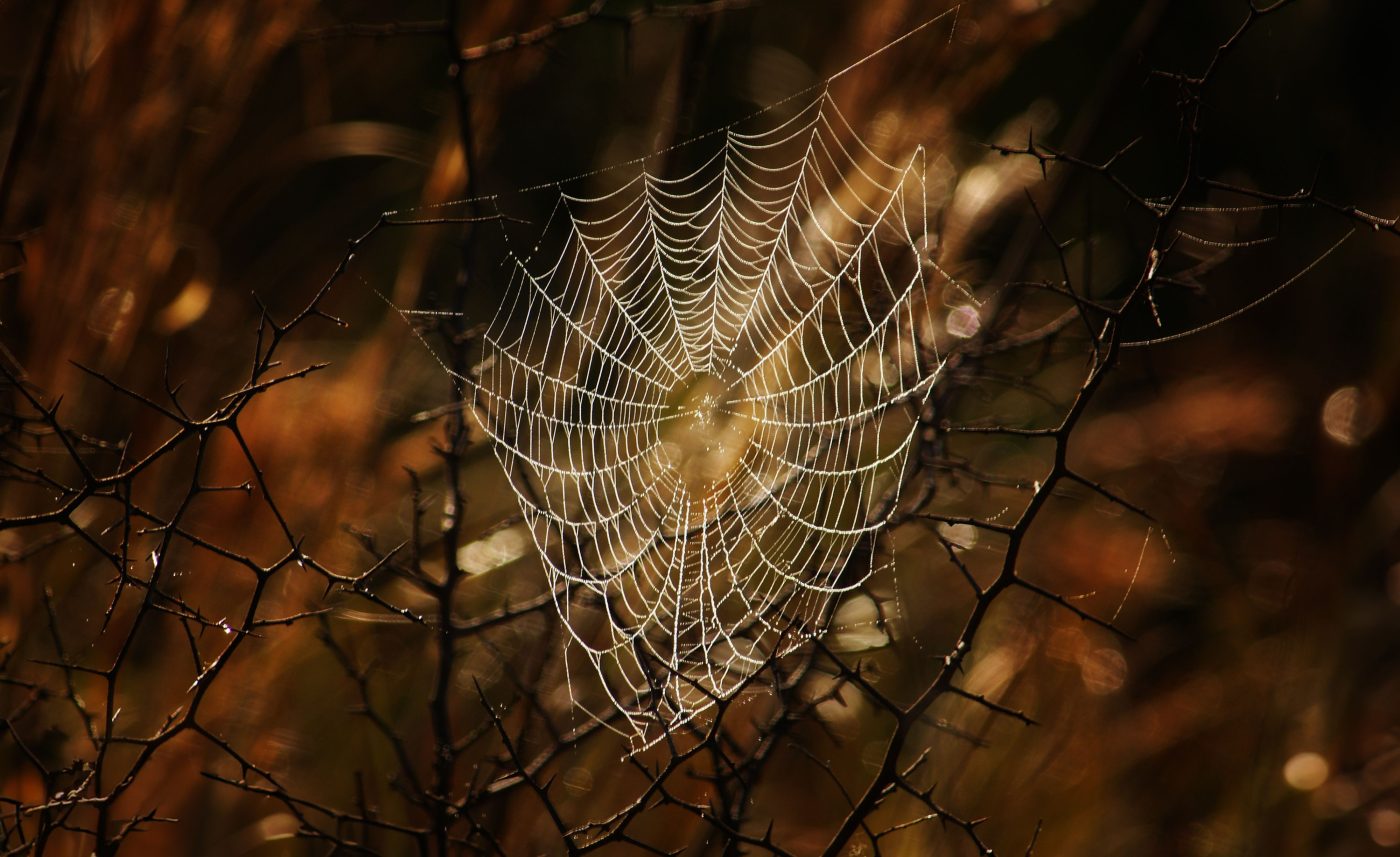
Suddenly my mattress was a raft on an enormous ocean, there were no walls. I was rocking along slowly and admiring the shimmer of silver in the water when I realized the shimmer was everywhere. There were millions of strings, spider-silk fine, running between me and the lamp, me and the walls, me and everything I thought was empty. No empty space. None. Just threads, in perfect geometry like a fishing net, moving just as a net on the surface of the ocean does.
I lifted a hand and the strings shivered, rippling out like a plucked guitar. I laughed—couldn’t help it—and the laugh itself shook the net, sent vibrations racing back, so I didn’t know if I was laughing or if the room was.
I woke up the next morning with a complete and utter awareness that those little strings, those world-threads, are there all the time. Always. There is no space between us. And those little strings go between one person to the next, they are a bridge, a connection and they wobble away at the slightest hint of energy … or emotion.
I should mention that “strange reaction” is the polite term; the medical one is “paradoxical reaction.” The things that relax most people have tended to do the opposite to me. My working theory is that some of us are set at such a loud, incessant internal chatter to begin with that the dial has only one direction left to go.
It is one of the reasons I was so relieved to learn that you do not need to have taken a psychedelic to train as a psychedelic-assisted therapist. The CPAT residential uses breathwork to facilitate non-ordinary states of consciousness. Trainees get a safe, substance-free understanding of something of the territory their patients will travel. For me, that is all I need.
Self-awareness and integrity is one of the six competencies. I had assumed it meant knowing my strengths. It turns out it also means knowing which chair in the room is mine. My place is beside the person in an altered state, steady and fully present, holding the space rather than entering it.
I realized that the failed human connection I was bearing witness to daily was real. That the pain I felt at witnessing the patient’s distress being minimized was real. That everything, and everyone, is connected.
Now, 13 years later, I am learning that “empathetic abiding presence” is a desirable quality of a psychedelic-assisted therapist, and that it refers to a way of being with someone that combines deep empathy with an abiding presence; ‘a steady, grounded, non-judgmental companionship that doesn’t waver even in difficult circumstances.
I reflect on how Daniel would have felt if the Psychiatrist had empathetic abiding presence. I admire the Psychiatrists that are leading the way in CPAT. I wonder how different all our health might be with our GP, therapist, clinician, had empathetic abiding presence.
From Melbourne I moved to a country within our country called East Arnhem Land and became a Rural Generalist. Straddling the space between psychiatrist and GP and psychologist, neither of each yet a little of both. A Venn diagram in which I meet in the middle of the three, in the space between. It turns out this is “the missing middle” of our mental health system, which in Australia at least, would number in the millions.
They are the patients who are a little too sick for GPs, not quite sick enough for Psychiatrists, and unable to afford Psychologists. Those with the resources (both external and internal) often seek out the therapists not often recognised by Western medicine, but who are a group who create more healing than those that shun them. The Buddhist teachers, the Yogis, breathwork, bodywork and energy work. The Shamans and Spiritual healers. In my own journey, both personal and professional, both patient and doctor, I encountered many of these types of healing therapies and had such a deep respect for their knowledge I began to study some of them (Yoga philosophy/history, Energy work, bodywork and meditation).
Currently my Venn diagram of professional knowledge has expanded so that I can see Chakras in human anatomy, meditation in physics, bodywork in the nervous system and energy work in death. By the latter I mean the energy that I have witnessed in death.
It has been a great privilege as a doctor to be present the moment a person passes on (when the death is expected and even welcomed, such as palliative care). Bearing witness to these moments is when my spiritual intelligence CPD took a new turn.
The very first occasion in a tertiary hospital as an Intern, when I was caring for an elderly man who had been admitted with a heart attack (more like broken heart) and had lost his love of his life, his wife of 60 years a month earlier. He never spoke of his own ailments, only of joining her. That took a full 8 days, and in that time, we got to know each other quite well.
Each morning and evening I could see his life begin to loosen from his body. Almost as though a gaseous haze followed him, like falling flakes of dead skin. His eyes were the first to lose their store, blue flecks became caught within his tears and sight slid down the channels of his face.
His hearing was dense with conversations, magpies, sports commentators and lawnmowers of eighty-five years’ noise. Like lime in pipes, life closed within his ears.
Late on the 8th evening of his admission, in the wandering hours, as nurses’ mumblings drifted by his heart failed, and his vitals beeped warnings for the nurses to call a Code Blue. Before the ‘crash-cart’ and Resuscitation team had moved I cancelled the Code with an assurance that did not fit an Intern, and certainly not one with the bush-kid imposter syndrome.
I closed his door behind me and held his hand as he took the last breath. The soul’s last sigh as I have come to call it. I felt a subtle cool brush of air, as the last of his life drifted through his skin and filtered between world threads, some-where.
Then I found myself turning to open wide the small window on the 4th floor hospital room. Years later a Shaman explained it was to let him fly.
Over the years that followed I witnessed time and time again the energy that left with death, which appears so enormous, so profound an altered state… and yet was never described in my medical studies at all.
Then one morning in East Arnhem Land, as the morning star, Venus, rose just before the sunrise, she was trailing behind her the rope that Yolŋu believe connects to the place where souls reside. I was fortunate to be part of a sacred women’s ceremony that I cannot elaborate on further, (out of both respect and my uninitiated ignorance). However, I felt the presence of a recently departed Elder sit beside me.
I was determined to try to understand the Soul.
Later that day I sat under the Tamarind tree on the beach of this Yolŋu Homeland, with the gentle lapping sounds of tropical sea on its shores, and I tried to calculate what this energy was. There is a famous and thoroughly dubious claim from 1907 that the body is 21 grams lighter after death. I knew the study was nonsense. I did the maths anyway. Using Einstein’s E=mc² and my very basic Physics 101: 0.021 kilograms, multiplied by the speed of light (approximately 3 × 10⁸ m/s) squared.
I stared at this incredibly large number, 1.9 × 10¹⁵ joules, and realized if the difference in weight between alive and death was even 1 gram, then that thing I saw leave a body so many times, the thing I was now prepared to call a soul, contains an immense amount of energy. Is our consciousness preserved, our sense of ‘I’ amongst that massive translation of energy, of presence?
If I had stayed in southern, western medicine as a GP or Psychiatrist, I never would have thought to ask the question about a soul. But working for 10 years in Yolŋu Country altered me, shifted me off standard Western medicine. I now see it was a direction similar to the attributes and qualities required in psychedelic therapy. Spiritual intelligence being one, and the delicate dance of trust between patient and doctor another.
Earning trust in Yolŋu Country required patience, silence, and authenticity. Elders might take two full minutes to answer a question, and I learned that silence is often the most respectful form of presence. I also learned that trust enhancement is a product of authenticity.
Gradually the trust spread outside the hospital walls, as Yolŋu became like family, and I even birthed my own family on their country. My boys were raised with weekends spent on the Homeland and learning to make spears, hunt and sit quietly around the fire listening to stories from their most Senior Uncle; a rare knowledge holder and high initiate for whatever it is these men endure each step of the way. I was changed by what I learned, from Yolŋu medicine, healing and ceremony.
Most importantly for the first time in my life I stepped out of my own world view and saw it for what it was.
I don’t think English has a word for stepping outside one’s own worldview. Perhaps that’s no accident. A language that spent centuries asserting its intellectual authority over others has had little reason to notice that its picture of the world is only a picture. English speakers may be the least likely of all to realise that the world looks the way it does because it is their view.
It is the same blind spot I carried into that interview room. What I did not tell the panel, because even I have limits, was the other thing my historical examples had in common: every one of them was also deeply spiritual. Western science kept their brilliance and quietly filed the rest under symptoms. The world caught up with each of them eventually, somewhere between 70 and 2,000 years later.
Other cultures have words that come closer. Ubuntu, from the Nguni Bantu languages of southern Africa, is often translated as “I am because we are”: the self-understood through others. It isn’t quite stepping outside a worldview, but it names the relational empathy that makes the step possible. Closer to home, Ngan’gikurungkurr Elder Miriam-Rose Ungunmerr-Baumann has shared the word dadirri: inner, deep listening and quiet, still awareness. When I first heard a CPAT lecturer describe “empathetic abiding presence,” dadirri was what came to mind.
Listening to the CPAT presenters, I have come to believe that a skilled psychedelic-assisted therapist needs exactly this. They need awareness of the worldview that surrounds them, the ability to set it down when sitting with someone in an altered state, and a felt sense of the connection between us all. Again and again through the course, I recognised lessons I had first been taught on Yolŋu Country.
Empathetic abiding presence. Yolŋu Elders taught me presence long before any lecturer named it. It was the first thing I taught the junior doctors who came to work with us: Yolŋu read authenticity and empathy with a skill I have rarely met anywhere else. If you are not truly present, they will know, often before you have finished your first question. The answers you receive will then be polite, agreeable and not quite true. Not out of deception, but because you have not yet earned the real ones.
Trust enhancement. On Country, trust doesn’t come with a job title. You earn it slowly, by showing up, by being authentic, and by being placed within kinship and held accountable to it. CPAT teaches that trust is the container in which a psychedelic experience can safely unfold. Yolŋu taught me that trust is a relationship, and relationships carry obligations that outlast the session.
Spiritual intelligence. Yolŋu healing does not separate the body from spirit, Country, kin or the Ancestors; illness and recovery belong to all of them at once. Aboriginal and Torres Strait Islander psychologists call this social and emotional wellbeing: health held through connection to body, mind, family, community, culture, Country and spirit. Health, in this view, does not belong to one person alone but to the threads that run between us. When those threads are severed, by dispossession, by removal, by a childhood like Daniel’s, people sicken. When they are mended, people heal. I had glimpsed those world-threads once, shimmering in a Melbourne bedroom; here were people who had never stopped seeing them. It is the frame psychedelic therapy keeps reaching for when patients return speaking of ancestors, of oneness, of a space between things that is not empty at all.
Self-awareness and integrity. On Country I learned that knowledge has custodians, and that most of it is not mine to hold or to speak. That is why I cannot tell you what happened at that ceremony under the morning star. Knowing the limits of my authority, knowing which chair is mine, is the same integrity CPAT asks of a therapist sitting beside someone at their most open and most suggestible.
Knowledge of effects. CPAT teaches the neuroscience: receptors, networks, the brain loosening its grip on its own predictions. Yolŋu Elders taught me a longer timescale: that the Ancestors are always acting on us. I think of that when I remember one of those brilliant few psychiatrists, who was already talking about epigenetics when most of his colleagues were still counting symptoms. And I think of Daniel. What if far more of what we carry is inherited experience than we have allowed? That might include not only trauma, cortisol and adverse childhood experiences, but something of the patterns we now label bipolar disorder, ADHD, addiction, chronic disease, even personality. What if our genes are the hardware, and what we live through (and what our parents and grandparents lived through) is the software?
Aboriginal and Torres Strait Islander scholars have been making a version of this argument for decades. They describe how distal, intermediate and proximal determinants of health explain why our nation has failed to close the Gap. Colonisation and dispossession, begun more than two centuries ago, still act on bodies today. Meanwhile connection to Country, kinship, language and culture, sustained for more than 50,000 years, remains profoundly protective.
Proficiency in complementary techniques. Yolŋu healing has never relied on one tool. Song, ceremony, bush medicine, time on Country and the work of traditional healers sit alongside the clinic, and often ahead of it. So does the yiḏaki, which is not only a sound but a vibration, and a healing. I once sat holding my Momu’s wrist (my grandmother by kinship), her pulse racing and irregular at 140, as the yiḏaki was held against her chest. I felt her heart slow beneath my fingers to 80, eased by whatever magic he was playing. Western medicine is only beginning to study what sound, vibration and breath do to the nervous system. Music is already central to psychedelic-assisted sessions, and breathwork to the CPAT residential.
Running parallel my career was my personal life – fourteen years of a deepening trauma which must also, for now, remain unnamed. In the REBUS theory lecture I thought about what it was that I suppressed to live in that world. To survive I severed my mind from my body. I had to ignore its constant warnings, the fight or flight of a sympathetic nervous system in hyperdrive. Reconnecting the two is ongoing work, I found somatic therapy, massage, meditation, and freediving essential. They remain on my self-improvement list, alongside breathwork, yoga, shadow work, and gratitude. Each helps rebuild trust within myself — a prerequisite to offering it to others.
The hardest thing to rebuild was the voice in my own head. For years it was as unkind as a mind can be to itself. What changed it was a sentence I had heard and half-dismissed for a long time: that God, or Source, or Universal Consciousness, whichever word you can bear, is in all of us and hears our every thought. If that is so, then all those years of speaking cruelly to myself were not confined to myself. While at that point I had no concern for my own emotions, I was thoroughly concerned for the emotions of others. I did not want to talk negatively to God, and I most certainly did not want that unkind running commentary to find its way out there, shivering through the silver strings, the world-threads, in the space between.
Anaïs Nin reminds us that we never see things as they are, only as we are. My path through medicine, psychiatry, Yolŋu Country, complementary practice and my own hard years has shown me how true that is, and why it matters. If the threads carry what we are, then who we are in the room is part of the treatment. What began as an academic curiosity about consciousness has become a lifelong study of trauma, healing and connection.
The six competencies are threads woven through my career and my life, and none of them is finished. In two decades of professional development, the only other training that named empathy, presence, trust, spiritual intelligence, knowledge, integrity and traditional healing as core to a healer’s work was taught by Aboriginal and Torres Strait Islander Elders and thought leaders. They did not need a randomised controlled trial to tell them. They have held this knowledge for tens of thousands of years.
Yolŋu already know what I once glimpsed for myself: that the shimmering threads are there all the time, in the space between us. Psychedelic-assisted therapy may be Western medicine finding its way back to them. If so, the most important competency of all may be humility: recognising that the map we are only now drawing has been held, walked and sung by the Custodians of this Country all along.
This essay was written by Dr Molly Garton FACRRM as part of Mind Medicine Australia’s Certificate in Psychedelic-Assisted Therapies (CPAT). Learn more about CPAT.
